
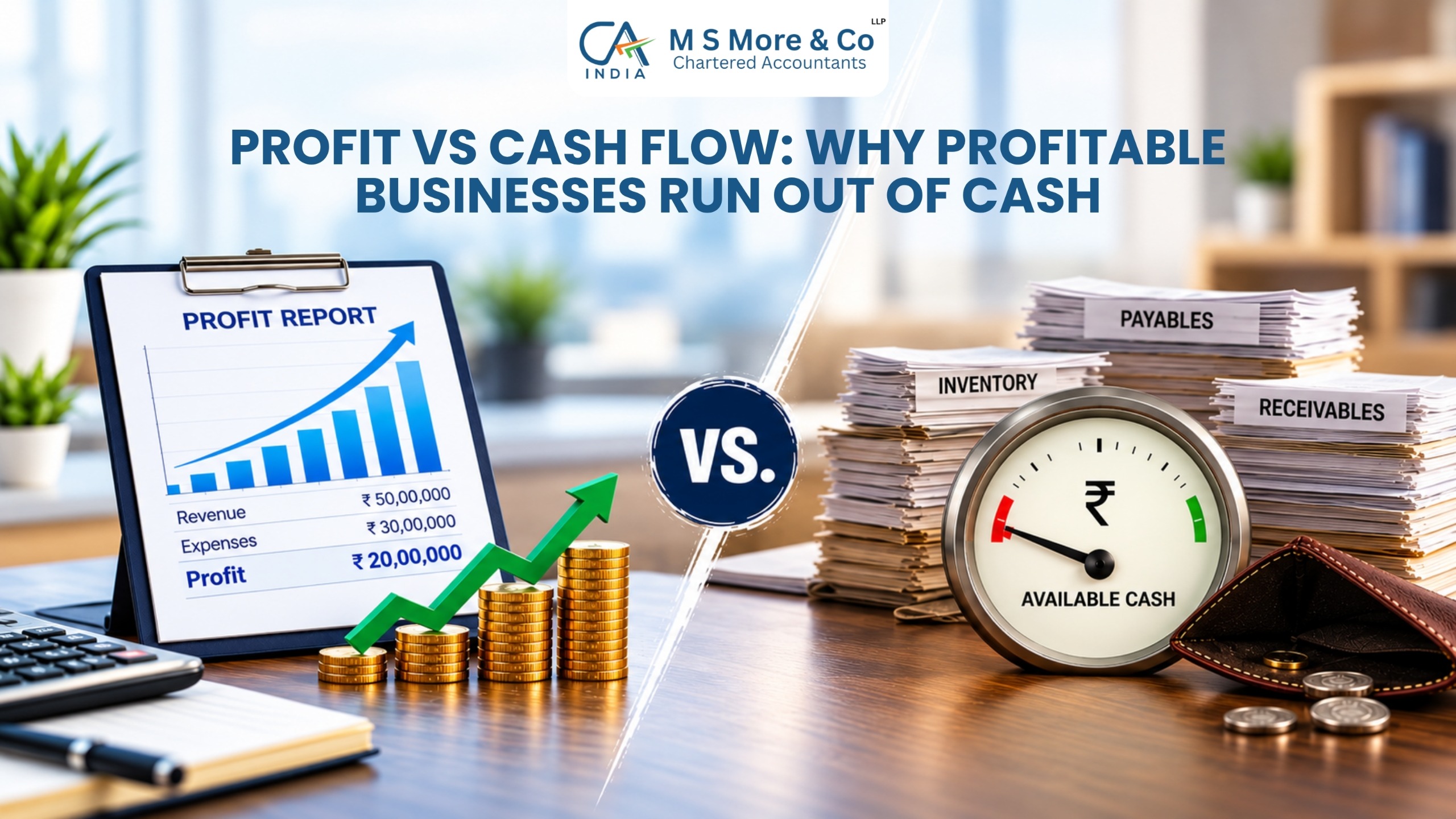

Imagine a business that closes the year with a net profit of ₹50 lakh. The owner is pleased, the accounts are signed, and the bank manager is impressed. Three weeks later, the same owner is struggling to pay salaries and supplier dues. How can a profitable business have no money?
The answer is a simple truth that many entrepreneurs learn too late: “profit is an opinion, but cash is a fact”
Two Different Measures
Profit is an accounting concept. Under the accrual system, income is recorded when it is earned and expenses when they are incurred, irrespective of when money actually changes hands. Cash flow tracks the real movement of money into and out of the bank account.
Consider a sale made on 31st March. It is booked as revenue immediately. But if the customer pays after 90 days, the profit exists only on paper while the bank balance stays unchanged. Salaries, rent, GST and loan instalments, however, must be paid in real money, not in accounting entries.
Profit tells you whether your business model works. Cash flow tells you whether your business can survive next month. You need both.
Why Profitable Businesses Run Short of Cash
- Money stuck in receivables
This is the most common cause. Many businesses attract customers with generous credit terms. Sales grow, profits grow, and the books look excellent. But every unpaid invoice is an interest-free loan to the customer. When customers delay payment, the business must still pay its own staff and suppliers on time.
- Cash locked in inventory
Stock is bought with cash but recovered only when it is sold. A business that stocks heavily in anticipation of demand, may show healthy margins on paper, yet have its funds sitting idle in a warehouse. Slow-moving or obsolete stock is worse, because it consumes cash and may never return it in full.
- Capital expenditure and loan repayments
When a company buys machinery for ₹40 lakh, the profit and loss account bears only the annual depreciation, not the full amount. The cash, however, has left the bank in one go. Similarly, the principal portion of a loan repayment is not an expense, so it never reduces profit, but it certainly reduces cash. A business can report rising profits while its bank balance shrinks every quarter.
- Taxes and statutory dues
Taxes are paid in cash, and often before the underlying money is collected. Advance tax is payable on estimated profits, even if a large share of those profits is still sitting with customers. GST is generally payable on the invoice, not on the receipt. A business may therefore deposit GST with the government for a sale whose payment it has not yet received.
- Growth itself
Paradoxically, fast growth is a classic cash trap. Higher sales demand more raw material, more staff, more stock and more credit extended to customers, all of which must be funded before the revenue arrives. This is known as overtrading. Many promising businesses fail not because they are unprofitable, but because they grow faster than their cash can support.
How to Protect Your Business
The good news is that cash problems are largely predictable and manageable. A few disciplined habits make a real difference:
- Prepare a cash flow forecast – Project inflows and outflows for the next 13 weeks and update it regularly. Do not rely on the profit and loss account alone.
- Track receivable days – Know how long customers actually take to pay, and follow up before dues become overdue.
- Negotiate better terms – Seek advances, milestone payments or early-payment discounts from customers, and use your full credit period with suppliers.
- Control inventory – Stock what sells, and review slow-moving items often.
- Match funding to need – Use long-term funds for long-term assets and working capital limits for day-to-day needs. Funding a machine with short-term credit is a common and costly mistake.
- Keep a reserve – A cash buffer or a pre-sanctioned credit line gives you room to handle delays without panic.
The Takeaway
Profit measures how well a business performs over a period. Cash measures whether it can keep performing. A business can survive for some time without profit, but it cannot survive a single day without cash when payments fall due.
So the next time you review your financials, do not stop at the bottom line of the profit and loss account. Turn the page and ask a more important question: where did the cash go?
