
What is Input Tax Credit (ITC)?
Under the Goods and Services Tax (GST) framework in India, businesses pay tax when they purchase goods or services for their business operations. The tax paid on such purchases is called Input Tax Credit (ITC). This credit can be used to reduce the GST liability on the goods or services that the business sells.
In simple terms: if you pay GST while buying something for your business, you can use that amount to offset the GST you owe on your sales.
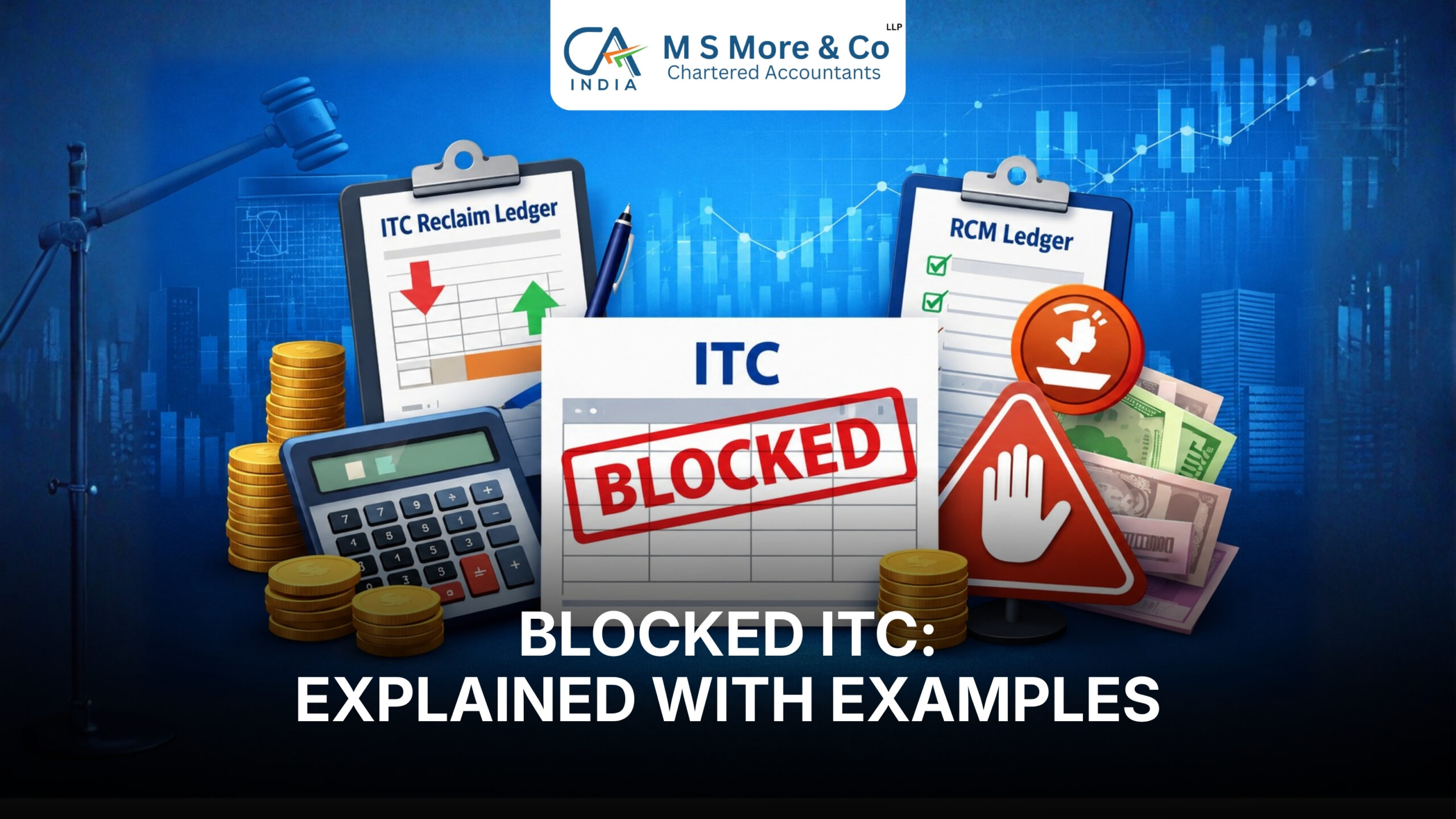
However, the law does not permit ITC on every purchase. Certain categories of expenses are specifically excluded from ITC eligibility. These are commonly referred to as Blocked Credits, and they are governed by Section 17(5) of the CGST Act, 2017.
Why Does the Law Block Certain Credits?
The rationale behind blocking ITC on specific items is to prevent misuse and to ensure that the credit mechanism is used strictly for business purposes. Items that are primarily used for personal consumption, employee benefits, or non-business activities are excluded.
List of Blocked ITC with Examples
1. Motor Vehicles and Conveyances
ITC is not available on the purchase of motor vehicles with a seating capacity of up to 13 persons (including the driver), unless they are used for:
- Transporting passengers as a core business activity (e.g., cab services, bus operators)
- Driving schools
- Further supply of motor vehicles (e.g., car dealers)
Example: A chartered accountant firm purchases a car for ₹15 lakh (including ₹2.7 lakh GST) for the use of its partners. Since the firm is not in the business of transporting passengers or selling cars, the GST of ₹2.7 lakh will be a blocked credit and cannot be claimed.
2. Food, Beverages, and Outdoor Catering
ITC on food and beverages, outdoor catering, and club memberships is blocked, unless these services are part of the core business of the taxpayer or are mandatory under any law.
Example: A manufacturing company spends ₹1 lakh on a team lunch, paying ₹18,000 as GST. This credit is blocked and cannot be claimed. However, if the company runs an employee canteen as required under the Factories Act, the ITC may be available subject to conditions.
3. Beauty Treatment, Health Services, and Cosmetic Surgery
ITC on beauty treatments, health and fitness services, and cosmetic or plastic surgery is blocked unless the taxpayer is in the business of providing such services.
Example: A textile company pays for its employees’ gym memberships. The GST paid on such memberships is a blocked credit.
4. Life Insurance and Health Insurance
ITC on life insurance and health insurance premiums is generally blocked. An exception is made where the employer is obligated under any law to provide such insurance to employees.
Example: A company voluntarily pays health insurance premiums for its employees. The GST paid on such premiums is a blocked credit. However, if a labour law mandates such insurance, the ITC may be permitted.
5. Travel Benefits Extended to Employees
ITC on travel benefits such as leave travel allowance (LTA) or home travel concession is not available.
Example: A company reimburses its employees’ holiday travel under LTA. The GST component on the travel tickets is a blocked credit for the company.
6. Works Contract Services for Immovable Property
ITC on works contract services used for the construction of immovable property (other than plant and machinery) is blocked.
Example: A company constructs its own office building and engages a contractor. The GST paid to the contractor is a blocked credit. However, if the same company constructs a commercial complex for sale, ITC may be available.
7. Goods or Services Used for Personal Consumption
Any goods or services used for personal purposes — and not for business — are ineligible for ITC.
Example: A business owner purchases a laptop for personal use and claims it as a business expense. The GST on such a purchase will be blocked.
8. Goods Lost, Stolen, Destroyed, or Given as Gifts
ITC is blocked on goods that are:
- Lost or stolen
- Destroyed or written off
- Distributed as free samples or gifts
Example: A pharmaceutical company distributes free medicine samples to doctors. The GST paid on these samples is a blocked credit.
Key Takeaway
Blocked ITC under Section 17(5) is a critical provision that every registered GST taxpayer must be mindful of. Wrongly claiming blocked credits can attract interest, penalties, and scrutiny from tax authorities. It is always advisable to maintain clear records differentiating business-use expenses from personal or employee-welfare expenses.
