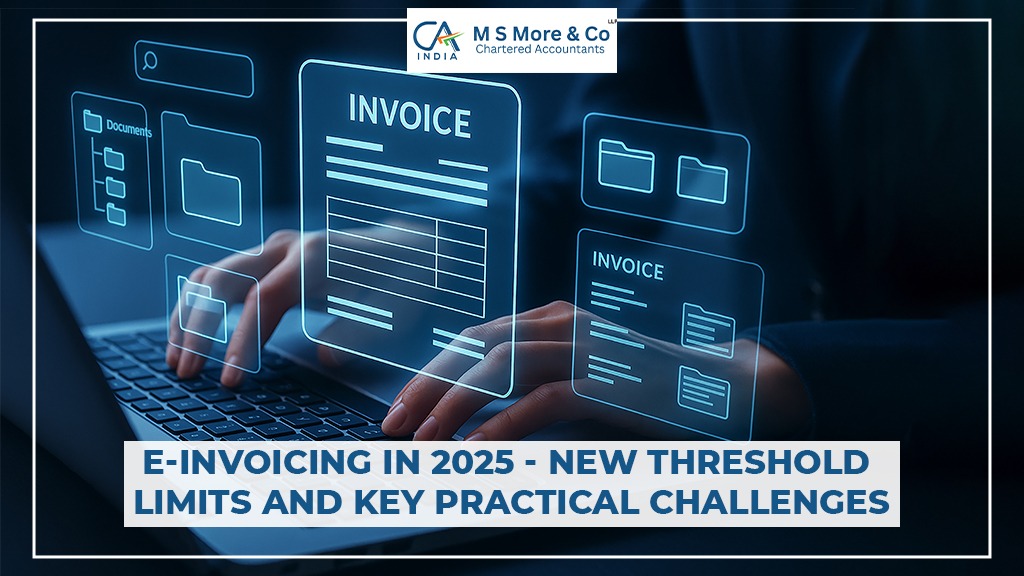

E-invoicing under the Goods and Services Tax (GST) system in India has undergone significant evolution since its introduction. Designed initially for large enterprises, it has steadily expanded to include more businesses across various sectors. As we move through 2025, new rules and compliance requirements have come into effect, making it important for taxpayers to clearly understand the updated thresholds and the practical challenges that accompany them.
- What Is E-Invoicing?
E-invoicing refers to the system of electronically validating B2B invoices through a government-approved Invoice Registration Portal (IRP). Under this process, businesses must upload their invoice data to the IRP, which verifies the information and issues a unique Invoice Reference Number (IRN) along with a QR code. This validated invoice, and not the original generated by the business, becomes the legally accepted document under GST.
The purpose of e-invoicing is to:
a) Standardise invoice formats across the country.
b) Reduce tax fraud arising from fake or back-dated invoices.
c) Ensure seamless flow of data between invoices, e-way bills, and GST returns.
d) Improve accuracy of Input Tax Credit (ITC) for buyers.
In simple terms, e-invoicing is a digital authentication mechanism designed to increase transparency and improve tax compliance.
- New Threshold Limit Effective April 2025
From 1st April 2025, businesses with an Annual Aggregate Turnover (AATO) of ₹10 crore or more must upload their B2B invoices, credit notes, and debit notes to the IRP within 30 days of the invoice date.
This is a major shift, because the 30-day reporting restriction earlier applied only to companies with turnover above ₹100 crore.
Key points to note about the new rule:
a) The 30-day deadline applies strictly to all document types covered under e-invoicing.
b) If an invoice is uploaded after 30 days, the IRP system will reject it.
c) A rejected invoice is considered invalid for GST purposes, which may impact ITC claims and statutory compliance.
d) The rule is applicable GSTIN-wise, which means each registered entity must follow the timeline based on its own turnover records.
The lowering of the threshold effectively brings thousands of mid-sized businesses under stricter compliance, emphasizing the government’s aim to tighten reporting and improve transparency.
- Key Practical Challenges for Businesses in 2025
Although the revised rules aim to strengthen GST administration, many businesses—especially mid-sized ones—face operational and technical challenges while adapting to the new norms. Some of the most common issues include:
i. Strain on Internal Systems and Workflows
Many organisations that recently entered the e-invoicing regime may not yet have mature systems to track invoice timelines.
• Accounting and billing teams must work faster to generate and report invoices within 30 days.
• Businesses still relying on manual or semi-manual processes may face delays in submission.
• Any internal approval delays can push the invoice beyond the allowable window.
This makes it essential for companies to streamline processes and ensure same-day or next-day reporting.
ii. Risks to Input Tax Credit (ITC)
If an invoice is not uploaded within the prescribed timeline, it becomes ineligible for IRN generation.
• A buyer cannot claim ITC based on an invalid or unregistered invoice.
• This can lead to disputes between suppliers and buyers, affecting business relationships.
• In sectors with high transaction volume, like manufacturing or logistics, this can significantly impact cash flow.
Thus, timely compliance is critical not just for suppliers but also for the financial health of their customers
iii. Technology and Software Readiness
Many mid-sized firms do not yet have fully integrated ERP systems.
• Older billing software may not support real-time IRP integration.
• Manual uploading of invoices is time-consuming and prone to errors.
• Businesses may need to invest in API-enabled invoicing tools or upgrade existing systems.
The shift towards digital compliance is pushing companies to revisit their technology infrastructure.
iv. Challenges During Transition
Whenever new rules take effect, a transition period often creates confusion.
• Invoices issued just before the effective date may get stuck in ambiguity.
• Staff may be unaware of the new rules, leading to delays.
• Businesses may accumulate a backlog of invoices and risk missing deadlines.
Clear communication and training are critical during this phase.
- How Businesses Can Prepare for 2025 Requirements
To manage compliance efficiently, businesses should consider the following practical steps:
• Automate invoicing and IRP submission through integrated ERP or GST-compliant software.
• Train finance and billing teams on the 30-day deadline and the consequences of non-compliance.
• Set up internal alerts or reminders for invoices approaching the cut-off period.
• Centralize compliance management, especially for organisations with multiple GSTINs.
• Conduct periodic audits to ensure timelines are being met and no invoices remain unreported.
Proactive preparation will reduce risks and ensure smoother adherence to GST norms.
- Conclusion
The expansion of the 30-day e-invoice reporting rule to businesses with turnover of ₹10 crore or more marks a major milestone in India’s move towards a robust digital tax environment. While the change aims to improve transparency and reduce fraud, it also introduces new operational challenges for businesses, particularly those that recently crossed the compliance threshold.
With timely planning, better systems, and stronger internal processes, businesses can adapt effectively and turn these compliance requirements into an opportunity to modernize their invoicing practices. The key is to act early, stay informed, and ensure that the entire organisation is aligned with the new regulatory expectations.
